Product Overview

The enterprise software engineering platform for complex codebases

KAVIA AI connects teams through code understanding, workflow automation, artifact generation, reviewable code, and validation across repositories and environments.

Project knowledgeSpec-based developmentReviewable outcomesGoverned delivery
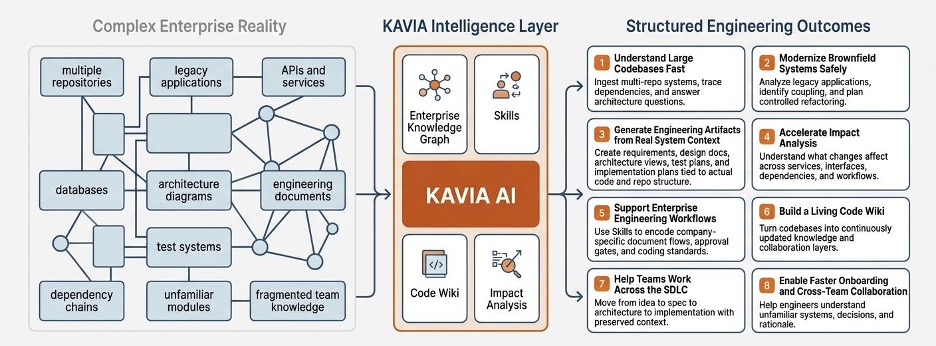
KAVIA intelligence layer turning complex enterprise systems into structured engineering outcomes
From complex enterprise reality to structured engineering outcomes.Knowledge, skills, Code Wiki, and impact analysis working together.

What KAVIA does

Built for teams, not just files

Most AI development tools help individual developers write code faster inside a file or editor. Enterprise software delivery is different. The hard work happens across systems, teams, repositories, architecture decisions, test plans, reviews, approvals, and release processes.

File-level tools

Helpful for isolated edits

Traditional AI coding assistance is often bounded by the open file, the current prompt, or recent local context. That can help individuals move faster, but it does not create a shared model of the system.

  • Context has to be repeatedly explained
  • Impact across repositories is hard to see
  • Specs, tests, reviews, and delivery artifacts remain scattered
KAVIA AI

Designed for enterprise delivery

KAVIA starts with the codebase as the foundation. It builds a persistent Enterprise Knowledge Graph of your software system, then uses that understanding to support planning, specification, code changes, testing, documentation, collaboration, and governed delivery.

  • Shared understanding across the team
  • Codebase-grounded answers and artifacts
  • Reviewable change across complex systems

The Enterprise Knowledge Graph

A living model of your software system

KAVIA maps your codebase across files, functions, dependencies, services, repositories, and relationships. This gives teams a shared understanding of how the system is structured, how it behaves, and what a proposed change may affect.

01

Onboard faster

Help engineers understand unfamiliar systems, dependencies, and decisions faster.

02

Analyze impact

Understand what a change may affect before implementation begins.

03

Trace root cause

Follow failures across repositories, services, and system relationships.

04

Ask architecture questions

Query dependencies, flows, modules, and architectural intent from a shared model.

05

Preserve knowledge

Keep institutional context available as teams and codebases change.

06

Ground every output

Improve specs, code, tests, and documentation with persistent project knowledge.

From understanding to trusted software change

KAVIA connects the full pathway from intent to delivery

KAVIA AI connects teams through code understanding, workflow automation, artifact generation, reviewable code, and validation across repositories and environments.

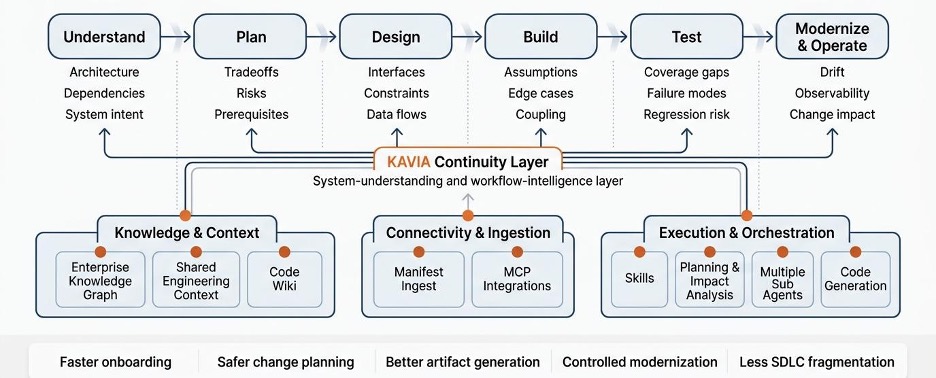
Diagram showing KAVIA continuity layer connecting Understand, Plan, Design, Build, Test, and Modernize and Operate
The KAVIA continuity layer.System understanding, workflow intelligence, connectivity, ingestion, execution, and orchestration.
01

Understand

Map the codebase, architecture, dependencies, and system behavior.

02

Plan & Design

Turn requirements, tickets, and design intent into specs, stories, architecture notes, and test cases.

03

Build

Generate reviewable code changes grounded in the actual system using familiar developer workflows.

04

Test

Create tests, inspect impact, and produce evidence that the work is ready to move forward.

05

Modernize & Operate

Track artifacts, approvals, revisions, and workflow history for confident collaboration.

Spec Builder

Make the development pathway explicit

In many engineering organizations, intent is scattered across documents, tickets, conversations, architecture notes, code reviews, and test plans. Spec Builder brings that pathway into a connected, knowledge-aware workspace.

01
Product and technical requirements
02
Epics and user stories
03
Architecture specs and detailed designs
04
Test cases and validation plans
05
Implementation guidance
06
Reviewable delivery artifacts

Spec Builder is not just a document generator. It is how KAVIA turns scattered engineering intent into a connected delivery pathway.

Development without the setup tax

Meet developers where they work

KAVIA gives developers familiar workflows through VS Code, CLI, Git, branches, and cloud-first sessions while preserving the shared project knowledge and enterprise collaboration layer behind the scenes.

$ kavia session start --branch feature-auth
Project knowledge loaded
VS Code workspace ready
Reviewable change set created
VS

VS Code workflows

Developers can work in the editor they already use while KAVIA maintains shared context, knowledge, and governed execution.

CLI

Command-line access

Agentic workflows can be invoked from the terminal and connected back to the same cloud knowledge layer.

Git

Git and branch alignment

KAVIA supports familiar branch and review practices so teams can move from generation to inspection without forcing an artificial workflow.

Cloud-first collaboration

Teams keep the scale, shared state, and governed collaboration of cloud execution without losing developer familiarity.

Built for large, complex codebases

Where local-only AI tools hit a wall

KAVIA is designed for large, layered, multi-repository systems where isolated file-level assistance is not enough.

01Brownfield modernization
02Embedded and platform software
03Android / AOSP-style systems
04RDK and OpenWRT-style projects
05Multi-repository enterprise applications
06Cross-team feature delivery
07Root-cause analysis across repositories
08Impact analysis before major change

Software delivery is a team sport

One shared workspace for every delivery stakeholder

Enterprise software delivery involves developers, architects, product managers, QA teams, engineering managers, security teams, and business stakeholders. KAVIA gives these teams a shared workspace for project knowledge, specs, code understanding, artifacts, reviews, approvals, and validation.

RoleWhat they get from KAVIA
DevelopersCodebase-grounded assistance, VS Code and CLI workflows, reviewable changes.
ArchitectsDependency understanding, impact analysis, architecture artifacts.
QA / TestTest case generation, validation plans, regression context.
Product / ProgramSpecs, stories, workflow visibility, delivery traceability.
Engineering leadersGovernance, reuse, auditability, progress visibility.

Designed for enterprise control

Govern AI-native delivery without losing engineering velocity

KAVIA is designed to fit the controls, deployment choices, integrations, and audit expectations of enterprise engineering organizations.

Deployment choice

Customer-controlled deployment options, private tenant patterns, and customer-cloud options where applicable.

Model flexibility

Support for customer-provided LLM keys and model flexibility aligned to enterprise policies.

Access controls

Role-based access, team controls, usage visibility, and workspace governance.

Auditability

Audit trails, document history, approvals, and revision tracking for AI-generated and human-edited work.

Workflow integrations

MCP integrations with systems such as Git, Jira, Confluence, GitHub Actions, and existing engineering workflows.

Security architecture

Built to meet enterprise security, compliance, and governance requirements across deployment, access, and data handling.

See KAVIA on your own codebase

If you are building, modernizing, or maintaining a complex software system, KAVIA can show how project knowledge turns AI output into trusted software change.